AI Text detectors have become common in publishing, hiring, education and content creation. They help to identify whether an AI tool produces the content. But what if you write something yourself or rewrite it, but still an AI detector gives you a high AI score?
A high score doesn’t automatically mean that your writing was AI generated. AI detection tools are statistical systems. They can produce false positives. Certain writing styles, highly structured sentences, formal language and even simple or repetitive phrasing can sometimes trigger them.
Instead of panicking or trying to "beat" a detector, the better approach is to understand why the score may be high and review the writing carefully. We also need to make sure the final work genuinely represents your own ideas and voice.
What is an AI Score?
An AI score within the AI text detector is an estimation of how much content is written by AI. It is a percentage of AI in your content. A high AI detection result means excessive use of AI in the content. However, a lower AI detection result means the content is human written.
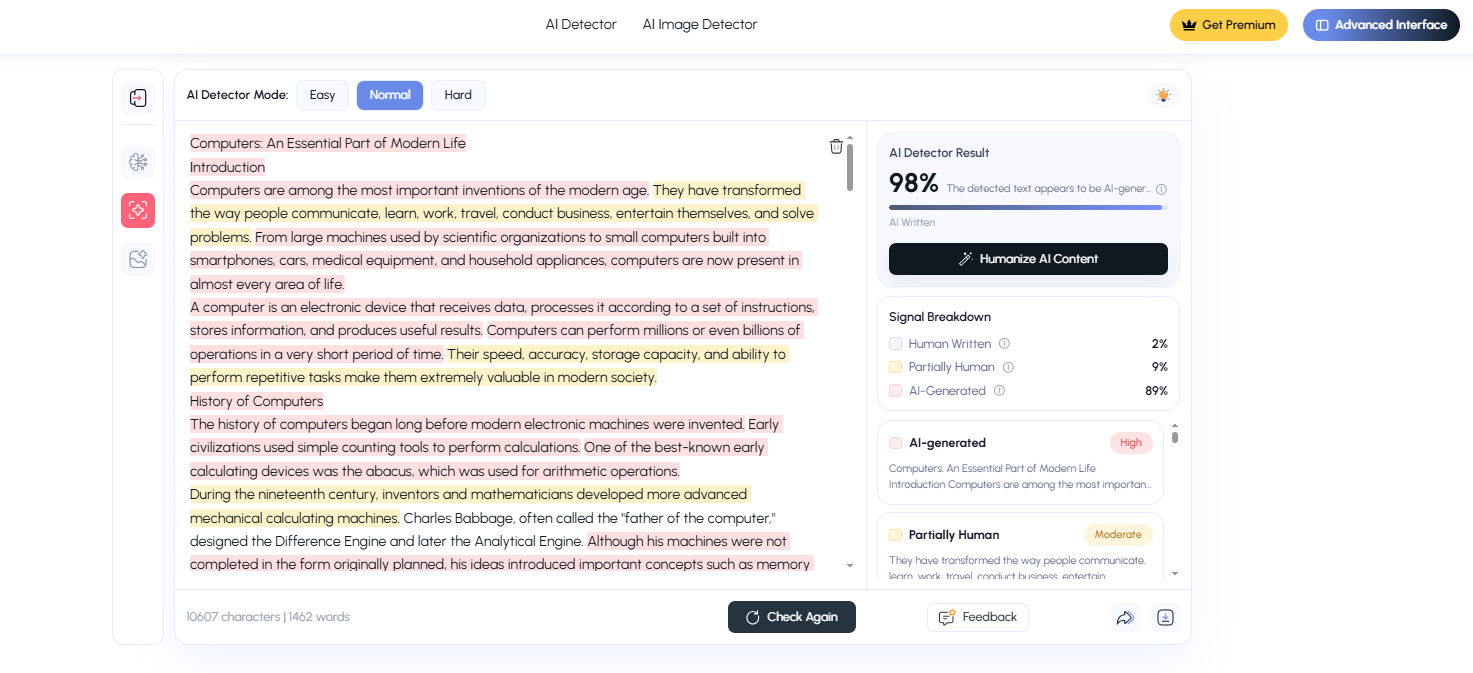
The percentage is not random. It is calculated by checking different AI signals in the content. The detector helps to analyze the content by checking the sentence length, writing style, repetitive patterns and linguistic and stylistic features.
This helps the detector know if this content is human written, AI manipulated or AI generated. The tool also uses NLP for AI detection. However, it is always suggested to also combine it with human judgment.
What Score is Considered a High AI Score?
It varies from institution to institution or company to company. Some institutes or companies consider a 10%+ AI score an unacceptable score. In contrast, some may consider more than 20% an unacceptable score. However some may want a 0% AI score.
At multiple universities, a 15% AI score leads to academic penalties or they can fail you as well. Some universities can accept a 30% AI score. So it depends on the institute or the company. When teachers were asked about AI usage, their answers were mixed.
Having a 50% score in content was unacceptable for some while some were not sure about a 100% AI score. This is because the content was technical, so they weren’t sure if the score should be considered or not.
Some teachers even asked their students to rewrite the content when they achieved an AI score higher than 50%.
The Detector is Not Always Right
The first thing to remember is that the AI detector cannot give you a perfect judgment. It can only analyze various patterns and provide a score. The tool doesn’t have direct access to your document’s history.
The checker can’t even know your thoughts or the exact process you use to write that content. Thus, a high AI probability score is just a prediction. It should not be considered a definitive proof of AI in the text.
False positives happen with many individuals and constantly with those who generally write content on a daily basis. This happens when content is highly formal, very organized, grammatically polished, and has repetitive sentences, etc.
How to Lower the AI Score in Content?
An overly even or generic writing is more likely to trigger AI signals. The best method is to write as you think. This approach helps you to write in rhythm. Based on our analysis, we have determined some techniques which can reduce the AI score in content. These are as follows:
Vary your Sentence Structure and Length
AI written content generally has the same sentence length. The rhythm of the content is also predictable. When a human is writing content, their sentence length keeps changing.
The sentences can be short, very short, long and sometimes descriptive. In short, humans write as they think but an AI tool writes in a consistent manner. Let’s explain it with an example:
AI Sounding: “Online learning is the most effective way of studying. Students attend classes from the comfort of their homes. They can use computers or phones for their lessons. They can watch videos and read online materials. They can also talk to their teachers online.”
More human: “Online learning is becoming a common and effective way of studying. Students can attend classes from home, a library or almost any place with an internet connection. They are not required to travel to school or college.”
You can see that the human version has varying sentence length and sounds more natural whereas the AI version has consistent sentence lengths. So, you need to write in such a way that your text contains varying sentence length and structure.
Add Personal Examples and Details
Adding personal examples and details also helps to reduce the AI score in your content. An AI tool can’t have an experience of its own.
Only a human has personal experience which they can share in their content. Hence, adding personal experiences can greatly help you to reduce your AI score. For example:
AI Version: “Online learning is more flexible and cost effective”.
Human Version: “To pay my tuition fee, I have to do a job. But then it became very difficult for me to manage studies with a job as their time was overlapping. So, I chose to study online. Now I am able to complete my shift and also study after that.”
In the above examples, you can see how adding personal experience makes the sentence more interesting. This is because there is a story behind the text, not just a simple sentence.
Use Natural Phrasing
When you write in overly formal writing, it will sound more artificial. This is why it is important to keep your tone natural and conversational. You can include contractions in your content. This includes it instead of it. This is just like writing how you’d speak out loud. For example:
AI Version: “It is important to note that nowadays students do not pay attention to their mental health.”
Human Version: “It’s important to note that nowadays students don’t pay attention to their mental health.”
As you read the examples by now, you will have knowledge of what sentences can make your content more human. In short, when you use contradictions and natural phrasing, the AI score reduces.
Use a Personal POV
AI writing tools often try to keep balance in content. But they end up sounding like they lack the actual perspective. Human writing is opinion oriented while AI writing tools don’t provide such opinions.
Providing opinions means writing your own views on a subject or about a matter in your content. For example:
AI Version: “There are many benefits of online learning beyond its cost effectiveness and flexibility.”
Human Version: “Although online learning is very beneficial, I think people should also consider that it minimizes social interaction and accountability of teachers and peers towards the students as well.”
With the above example, it’s clear that the sentence having a personal point of view sounds more authentic than the one which is entirely formal.
Avoid Generic Language
AI writing tools write content in generic terms. They don’t provide specific details. AI tools write in such a way that “in today’s evolving world”, “in today’s society” etc. They don’t name the thing directly. For example:
AI Version: “Various people face multiple challenges in modern workplaces”
Human Version: “Various people have to deal with back to back online calls, no work life balance and always look online on their CRM.”
Moreover, content in which relevant language is used is more trustworthy. Such as, a law site uses terms like Affidavit, jury, etc.
Use Stealth Writer Humanizer
When you are done with the whole process, like you have added examples, used natural phrasing and a personal point of view but the AI score is still high. In this case you need to use our AI humanizer.
But having access to a tool doesn’t guarantee you the desired results. You also need to have a proper understanding of its usage. When you know how to use Stealth Writer, you will select the most suitable options for your content. In short, you will get the results you want.
After you have got the humanized version, you need to review and edit it. This will help you remember what’s written in the content and you will not hesitate to take full responsibility for the content as well.
Read it Aloud
This is probably the easiest way. You just need to read your text aloud. Read every sentence carefully and if any sentence sounds off to you, change it. When you read your content aloud, it helps you remove the parts that don’t match your content’s flow.
More importantly, decreasing your AI score by adding your personal experiences makes your content stand out from the rest. Your content will then be more natural and engaging and will really feel like an actual human wrote it.
Don't Randomly Add Mistakes to Your Writing
Commonly when people see a high AI score, they try to add mistakes in their content. They usually add spelling mistakes, unnecessary punctuation, awkward grammar and strange wording.
This is a really bad approach.
If you write content yourself then making mistakes deliberately makes your content even worse. Your content will look careless and it will also affect your credibility with the teacher, employer, client or editor.
A good writer doesn’t make such mistakes only for the content to be considered human. You need to focus on clarity, precision, originality of thought and accurate attribution.
Be Transparent About AI Use
If you use an AI tool actively for working on the document, your response should be based on the rules of the environment you’re working in or submitting it.
Some schools, universities, publications or employers allow taking help from AI while they also restrict some. The important question here is not whether you involve AI for writing but it is whether it complies with the rules of the organization.
Let’s discuss it with an example. An organization permits you to use AI just for brainstorming and grammar assistance. However they didn’t allow you to produce the final answer using AI. There’s another organization that requires disclosure of AI assistance.
So, you need to check the v n b of your organization.
If you need to disclose AI assistance, then you need to be honest about your usage process. Disclosing the use of AI is safer than denying its involvement as it can lead you to worst case scenarios.
What If the Score is High Even After You Rewrite It?
If you rewrite the content on your own words but the detector still gives you a high score. Don’t keep on making continuous changes in the content. You need to:
Read the detailed feedback on your content
Identify the sections that the tools flagged
Review those sections for generic, vague or repetitive language.
Improve clarity and specificity.
Preserve your earlier drafts and revision history.
Verify facts and citations.
However, sometimes even if your writing contains proper and clear text, the detector still flags it as AI generated. In this case you just need to make a few changes to make sure that you get a satisfactory automated score.
Final Thoughts
It is really frustrating to get a high AI score for any writer. It is especially annoying in scenarios when you genuinely write the content on your own. However, the best response is not to panic or manipulate the text deliberately.
You need to treat the detection score as a signal. It is not a definitive score of your writing. Review your writing for clarity, specificity and originality. You need to make sure of the accuracy of your evidence and citations. Preserve your writing process. Understand the AI-use rules that apply to your situation.
It is important to remember that a detector score is not the same thing as proof of authorship. A strong piece of writing should ultimately be judged in context, by the quality of its ideas, evidence, reasoning, sources, and documented writing process.
If you genuinely wrote the work, your goal should not be to make it "look less like AI." Your goal should be to make it accurate, specific, thoughtful, and unmistakably representative of your own work.
FAQs
Does Editing AI-Generated Content Make It Human-Written?
If you edit AI written content, it will not change its authorship. Content totally written by an AI writing tool is solely AI written. If a person makes minor changes only, it doesn’t change the fact that AI produced that content.
The question is not about the words you changed. The important question is if your institution, employer or client accepts this AI assistance.
Does Content Length Affect AI Detection?
Content length can affect the evaluation process of the detector. If your content contains short passages, it will be difficult for the detector to assess the document.
However, if you increase the words in your content, it will alter the results. The most important thing is solely the quality of content.
Can an AI text Detector Flag Technical or Scientific Writing?
Yes. Technical and scientific writing can sometimes receive unexpected AI detection results.
Scientific content often uses standardized terminology, structured explanations, precise language and recurring sentence patterns. These characteristics help to communicate technical information. However, such patterns can also signal to the checker that content is AI generated.
Because of this, you need to evaluate technical content in its context and not solely on detector percentage.
Can Grammar Checkers Increase an AI Detection Score?
They can potentially change the characteristics of your writing. It depends on the type and extent of editing they perform.
Basic spelling and grammar corrections are different from tools that substantially rewrite sentences or paragraphs. Extensive automated rewriting can alter your original writing style.
If your organization has rules regarding AI assisted editing, check whether your grammar or writing tool falls within those rules.
Should I Tell My Client About AI Assistance?
It depends on the agreement with your client’s AI policy. Some clients prohibit you from using AI, some may permit you to use it for brainstorming or researching, while some may need disclosure.
The safest approach is to understand the client's requirements before using AI. You need to disclose assistance when the agreement requires it.
Is It Better to Ignore an AI Content Detector Completely?
Not necessarily. You can use an AI text detector tool for detection purposes. Especially when you want to identify writing that may be overly generic, repetitive or formulaic.
However, it should not be treated as an unquestionable authority. The best method is to consider the result alongside the quality of the writing. You also need to consider the content's accuracy, the applicable AI policy, and evidence of how the work was created.