AI-generated content is becoming increasingly common across the internet. Most of the content on the internet is AI-generated. Besides content being AI, there are various points because of which it's hard to believe in AI-written text.
One of those points is that AI usually provides false or misleading information. This is the main reason professionals don’t trust AI written text. Because of the increasing use of AI, there is a question mark on the authenticity of the content.
To tackle this issue, Stealth Writer AI Detector comes in. It analyzes written content and provides an AI detection score based on linguistic, structural, and statistical patterns. It doesn’t simply look for a few common AI phrases.
It evaluates characteristics such as sentence structure, vocabulary, tone, sentence length, writing patterns, grammar, punctuation and other signals which are present in AI generated text.
What is an AI Detector?
An AI text detector analyzes text to estimate if AI wrote the content or a human. AI writing usually has recognizable patterns. For example, it uses predictable sentence structures, repetitive transitions, consistent sentence lengths and generic wording. The tool analyzes these characteristics. The detector evaluates these characteristics to generate a detection score.
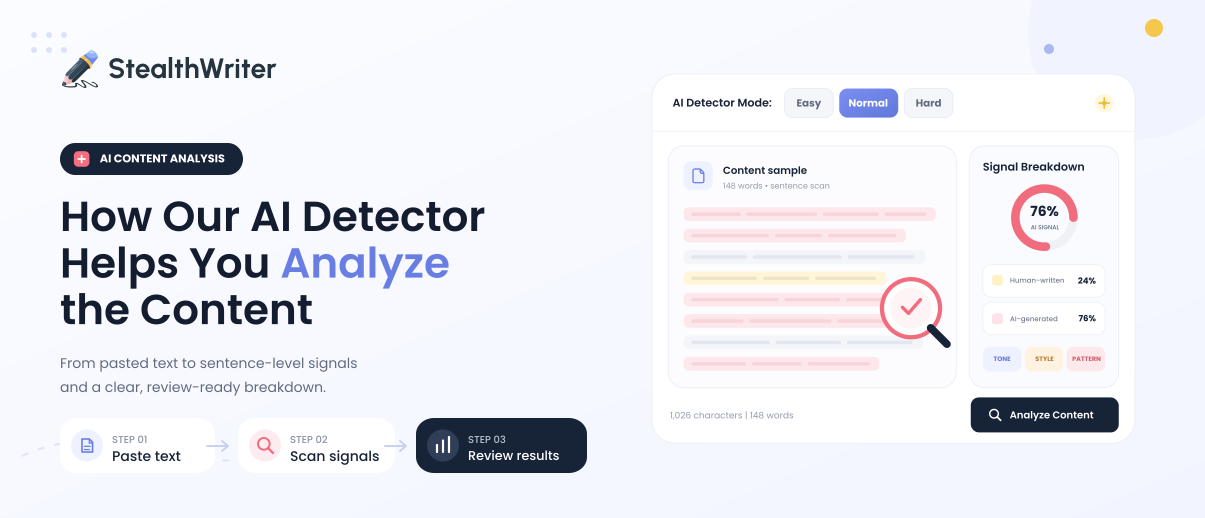
Stealth Writer’s AI detector examines individual sentences. It also checks tone, vocabulary, sentence length, structure and patterns. Its results give you a probability score of how much of the content is AI or human.
The tool is helpful when you want to review AI-assisted content before publishing, analyze articles and blog posts and want to check academic or educational content. It also reviews business documents and paraphrased content. Hence, it lets you know about the overall originality and naturalness of your writing.
What Techniques Does Our Checker Use?
Our AI detection tool uses the same techniques that most AI writing tools use. With the help of these techniques, our detector can check the content more precisely.
Machine Learning (ML)
Machine learning is important for AI content detection. It doesn’t rely on rigid rules. The detection system studies large amounts of text. It identifies the patterns that are usually present in AI writings. The tool trains itself on this data to find the hidden statistical signals and structural fingerprints.
Our tool uses ML based analysis to examine different aspects of your content. Machine learning also allows our detection technology to grow with the change in AI writing models.
As AI models evolve, they are becoming better at producing natural and human-like text. Our AI detection software recognizes new patterns rather than depending only on older indicators.
Natural Language Processing (NLP)
Natural Language Processing (NLP) helps computers understand, interpret and analyze human language. Written language contains many characteristics that the tool can measure and compare. Hence, it is an important part of AI content detection.
When you submit content to Stealth Writer's AI Detector, NLP-based analysis examines factors such as sentence structure, word choice and overall writing patterns. These characteristics provide useful signals. Thus, they help determine whether the text has patterns commonly found in AI generated content.
NLP allows the detector to look at how words work together within sentences and paragraphs. This makes it possible to analyze in depth the linguistic characteristics of your writing.
AI Watermarks
AI watermarks are another technology which helps to identify AI generated content. An AI watermark is a hidden or statistical signal that is embedded into content during the generation process.
Our compatible detection tool analyzes the text. It looks for the statistical pattern of the watermark. Hence, by identifying these hidden patterns, the detector flags it.
What Factors are Important for Content Analysis?
Other detectors generally look for patterns, not the specific "AI words." Stealth Writer's AI checking tool considers several characteristics of writing, including the following.
Perplexity
Perplexity relates to how predictable the sequence of words is within a piece of text. AI generated content can sometimes follow highly predictable language patterns. It may result in lower perplexity.
The detector can use this type of statistical signal for its broader analysis.
Burstiness
Burstiness refers to variation in sentence structure and sentence length. Human writers often switch naturally between short, medium, and long sentences. AI generated writing usually has more consistent sentence patterns.
Therefore analyzing this variation provides another signal for content evaluation.
Writing Style
The overall writing style can also provide useful information. AI generated text has a generic and consistently polished style. The detector analyzes tone and writing characteristics. Because of this, our tool helps determine whether the content has AI patterns in it.
Repetitive Patterns
AI-generated text contains repeated phrases, transitions, structures or similar expressions. The detector examines these patterns as part of its content analysis.
Linguistic and Statistical Features
Our detector analyzes various factors in the content. It includes word frequency, grammar consistency, punctuation, syntax, vocabulary and writing patterns. By checking these characteristics, the tool provides a broader view of the text.
How does it Knows if the Content is AI Written?
Stealth Writer's AI detection tool makes content analysis straightforward. You don't need to manually analyze every sentence for AI signals. It examines various characteristics of the text and patterns.
Analyze Sentence Structure
Our tool analyzes the sentence structure to analyze AI in the content. In AI content, there is usually a consistent sentence structure. Sentences follow similar patterns in the entire article. It analyzes these predictable rhythms.
The tool analyzes the individual sentence, not the overall content of the document. Afterwards, it provides a detailed analysis of the content.
Examine Writing Tone
Writing tone provides useful signals which are important in content analysis. AI-generated text can sometimes sound generic, overly formal, or unusually polished. Human writers generally introduce more natural variations in expression, phrasing and tone.
Our detector analyzes the tone of the content along with other linguistic characteristics. Its analysis helps determine if your writing contains patterns that various AI writing tools use.
Evaluate Sentence Length and Variation
Human writing naturally contains variation. A person may use a short sentence to explain a point. Afterwards, they can use longer sentences that provide additional context.
However, the sentence lengths and patterns in the AI-written content are more predictable. The sentences are usually longer in the AI generated content. Our detector examines sentence length and variation to provide the result.
Analyze Vocabulary and Word Usage
AI written content has various repeated patterns. In AI written content, you can see certain words, phrases and expressions in abundance. The detector analyzes vocabulary and word related characteristics to identify these patterns.
Because of the vocabulary or word usage, our detector determines the likelihood that the content is AI influenced or not.
Identify Repetitive Patterns
Repetition is another characteristic that you can see in AI generated writing.
AI content uses similar transitions, sentence structures and phrases throughout content. Our detector looks for these recurring characteristics for text analysis.
It analyzes repetitive patterns along with linguistic and statistical signals. Afterwards, it provides an indepth report of the content.
Which AI Models Can Our Tool Detect?
Individuals are not using a single chatbot or tool for content creation. There are different AI writing tools available. All these tools have different writing patterns and structures. So professionals require an AI checker that can detect AI content irrespective of the tool.
Our detector can detect the content of multiple AI models. This includes ChatGPT, GPT -4, GPT 5, Gemini, DeepSeek, Grok and Claude, etc.
It uses Machine learning, natural language processing and also analyzes linguistic and statistical patterns to detect the content.
Moreover, if any new AI tool emerges in the future. The tool can detect its content as well. This makes the detector useful when you don't know which AI model created the content.
What if the Content is Mixed or Hybrid?
Not all AI tools help to generate content completely. Some individuals generate a draft using AI. They may rewrite certain paragraphs or add personal examples. This type of content contains both the AI and human written sections. Hence, it is called hybrid content.
Stealth Writer's AI checker analyzes this type of content as well. AI generated patterns can remain detectable even when the content has been modified or combined with human written text.
This makes hybrid content analysis practical. It helps to review articles, assignments, reports and other documents.
Which AI Scan Mode Should You Choose?
There are 3 different AI scan options available in our tool. You can choose any option as per your requirements. You can choose easy, normal or hard mode. Easy mode is for a basic AI content check. Normal mode is for standard content analysis.
On the other hand, hard mode is for thorough and indepth content analysis. These modes allow you to choose the level of analysis. It totally depends on the type of content you are reviewing.
Conclusion
Our tool analyzes content through multiple linguistic, structural and statistical signals. It doesn’t rely on specific AI words or phrases. It examines factors such as perplexity, burstiness, sentence structure, vocabulary, writing style, repetitive patterns and other characteristics of the text.
The tool also analyzes content which different AI models write. It evaluates mixed or hybrid content. With Easy, Normal and Hard scanning modes, users can select an analysis level according to their requirements.
So whether you are reviewing an article before publication or analyzing professional content, our tool helps you to analyze content so you can make more informed decisions.
FAQs
Can your detector check content in different languages?
No. Currently, this option is not available in our tool. It can only detect AI in content that is written in the English language.
Can your tool detect even if content is edited?
Yes. AI content can still contain detectable patterns even after you edit it. However, human rewriting can change the linguistic characteristics of the original text. It can affect the detection result. This is why you need to treat an AI score as an indication, not as definitive proof.
Why is short content hard to detect?
Short passages provide fewer linguistic patterns for an AI detector to analyze. As a result, detection results from very short pieces of text may be less reliable than results from longer passages containing enough sentences and writing characteristics for analysis.
Does changing a few words make AI content undetectable?
Simply replacing a few words does not remove all AI related patterns from content. Our tool considers broader characteristics. It includes sentence structure, vocabulary, syntax, and writing patterns rather than focusing on individual words.
Can an AI tool replace human content review?
No. Nobody can replace human content review with an AI tool. Our tool provides useful signals about a piece of content. But human review is still important for evaluating accuracy, originality, context and expertise.
What can affect an AI detection score?
Several factors can influence a detection result. These include the length of the content, sentence structure, vocabulary, writing style, editing, paraphrasing, complexity, and the characteristics of the original AI model. Even if a human writes the content, it can still affect the result.
Why is longer content often easier to analyze?
Longer content generally contains more sentences and linguistic signals. This gives our tool more information to evaluate. Very short content provides fewer signals. This can make a reliable assessment more challenging.
Can technical or academic writing be incorrectly flagged?
Yes. Technical, academic and highly formal writing often follows structured language patterns. Some of these characteristics can also occur in AI generated content. Such writing may sometimes receive a higher AI score even when a person writes it.