Artificial intelligence has changed image creation, editing and sharing. AI tools can generate highly realistic photographs, illustrations, portraits, product images and artwork. It is becoming very difficult to find if a human created an image, an AI or it’s a combination of both.
This increases the necessity of AI image detectors. These are software tools which analyze an image and give an estimated score. This estimation helps us know if the image is AI generated or manipulated.
But an important question remains: How accurate are AI image detectors? People also ask how much you should trust their results.
The short and most accurate answer is that AI image detectors are useful. However the results should generally be treated as probabilistic evidence and not as absolute proof. Accuracy varies based on the detector, the image generation model, image quality, editing history, compression and the type of image being analyzed.
It is important to understand these limitations for everyone using AI detection tools. It is essential for detecting images related to education, publication, journalism, research or digital forensics.
What is an AI Image Detector?
An AI image detector is an AI image detection tool which analyzes an image to determine if it’s AI modified or human created. Detection involves analyzing Pixel level patterns, image textures, edges and fine details, lighting and shadows, facial characteristics, repeated visual patterns and image structures etc.
There are multiple AI detectors available today. They solely focus on an estimation score of AI detection. But Stealth Writer does more than just estimate the AI probability.
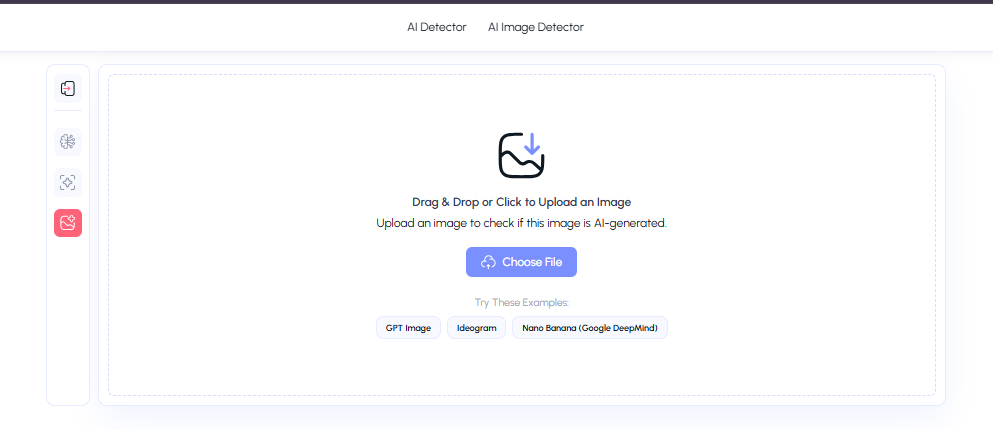
You also know that not every AI image generator provides the same results. The images that different models generate vary. So do their statistical and visual characteristics.
For example, you used ChatGPT, Ideogram and Google’s Nano Banana to generate an image. We get AI generated images. Now all these images have different characteristics. A detector that can differentiate these possibilities provides more information than a simple AI vs. real classification.
How Does AI Image Detection Work?
AI image detection relies on machine learning models. The model has learned patterns which is linked to synthetic and traditional image creation. An image can look absolutely realistic to a human observer.
It can contain subtle statistical patterns that a detection model recognizes. You can see patterns like faces, hair, hands, text, backgrounds, reflections or shadows etc.
Stealth Writer AI image detector analyzes visual patterns and structures. It doesn’t rely on watermarks or metadata for its detection process.
This is important as metadata can be removed, modified or lost when an image is edited or uploaded to another platform. This helps to determine whether characteristics within the image itself resemble AI generated imagery.
Why an AI Probability Score Matters
One of the most common results from an AI image detector is an AI probability. For instance, a detector can report that an image has an 88% likelihood of being AI-generated. This number provides a quick way to understand the overall probability.
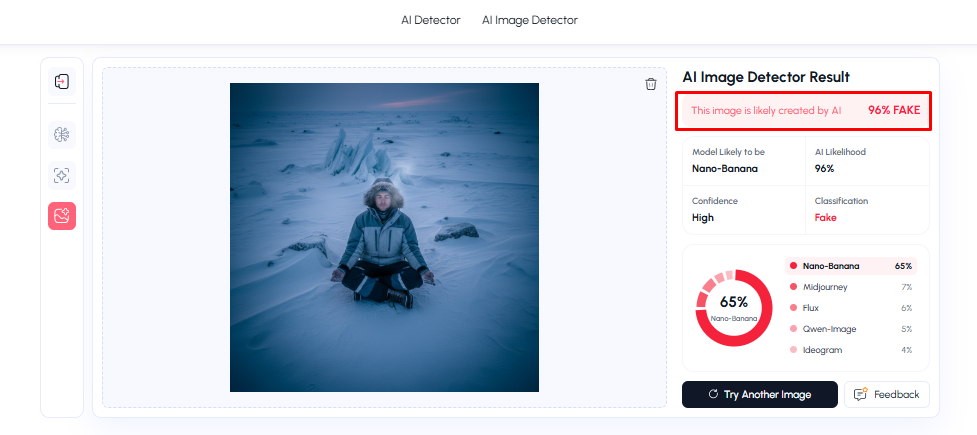
However, you shouldn’t consider the probability score as absolute proof. If the detector says that an image has a 90% AI likelihood, it means the detector finds strong characteristics linked with AI generated imagery.
The results depend on the algorithms, image quality and the characteristics of the image being analyzed.
Features of Stealth Writer AI Image Detector
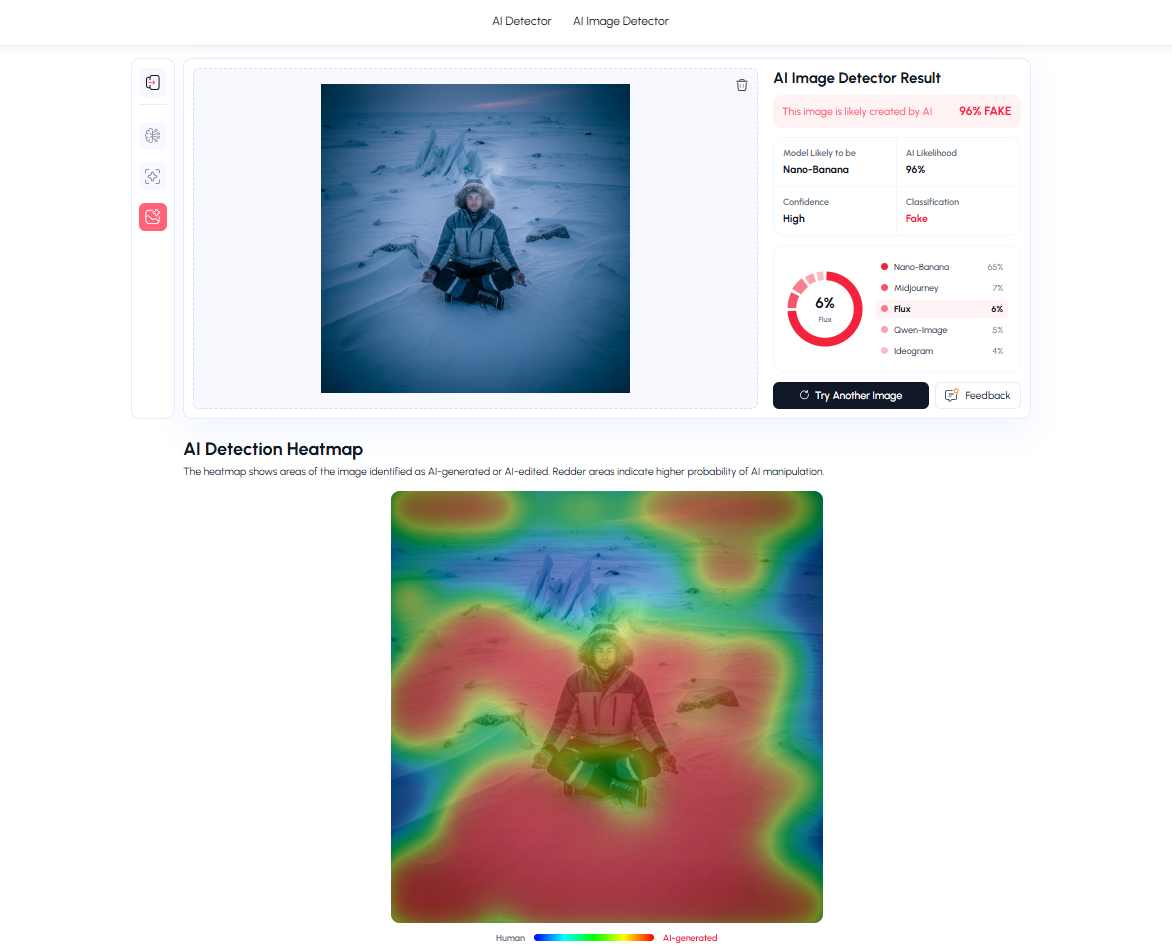
There are various features of the Stealth Writer AI image detector. Users can upload an image, run the detection process and get a score, along with the suspected generative model and a heatmap for further analysis.
The most interesting thing is that it doesn’t stop at a single “AI” or “real” label. The results provide more accurate information.
AI Likelihood
The AI likelihood represents how strongly the detector believes that the image contains AI characteristics. You can see the degree to which the tool identifies AI-related characteristics.
This makes the result more informative because an image with a very high AI likelihood can be distinguished from one where the detector finds only weak or ambiguous evidence.
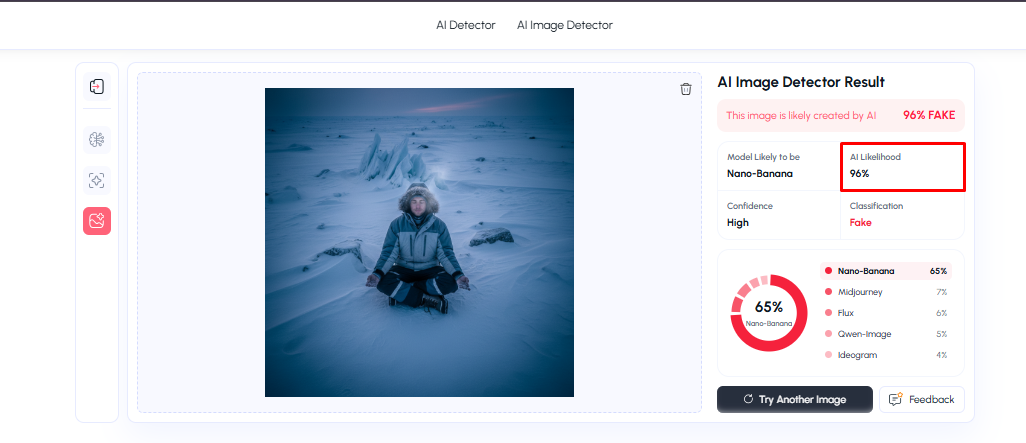
Likely AI Image Generator
Another useful feature is Stealth Writer AI detector can identify the AI image-generation tool or model (used to generate the image). For instance, when testing sample images generated using systems such as GPT Image, Ideogram or Nano Banana.
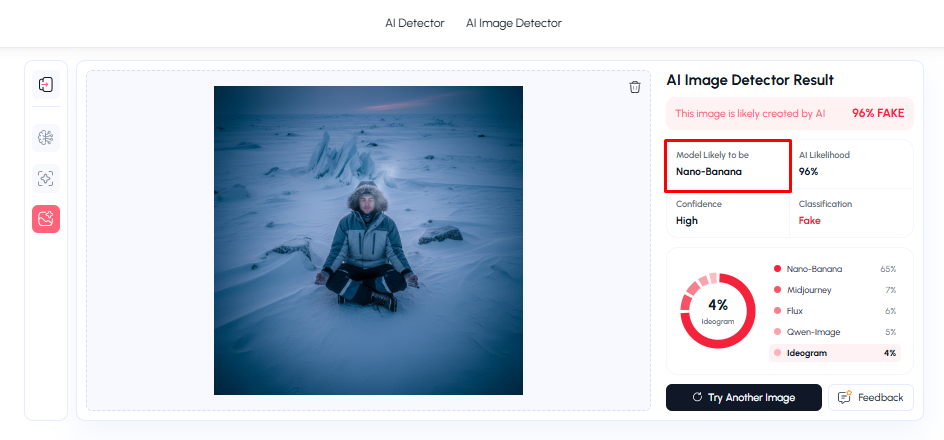
The detector can do model specific analysis. This is especially helpful as modern AI images are not generated by one universal tool. Different models have different visual characteristics. So when you get the likely source, it can provide you with additional context for image analysis.
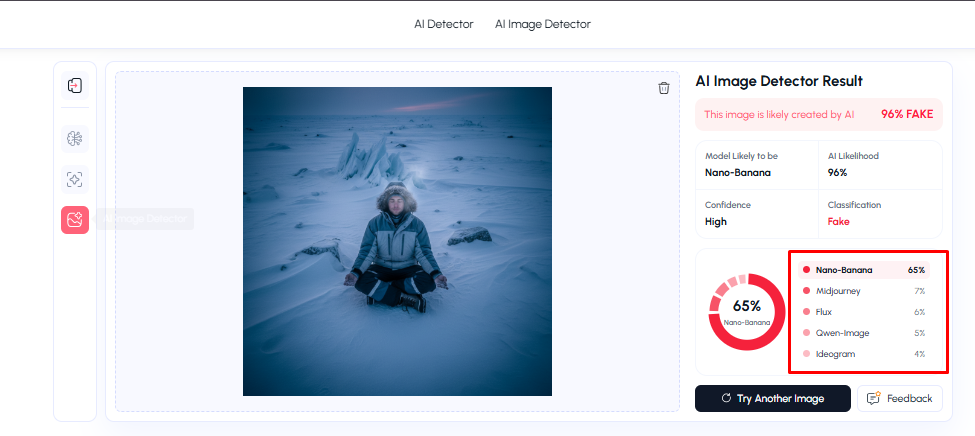
In short, an image is generated by a tool or it is edited after generation. The AI image detector can still detect AI in the image.
Confidence Level
Stealth Writer also provides a confidence level. This shows how confident the tool is in its classification. The AI likelihood answers a question such as: How strongly does the image appear to contain AI-generated characteristics?
The confidence level addresses: How confident is the detector in the conclusion it has reached?
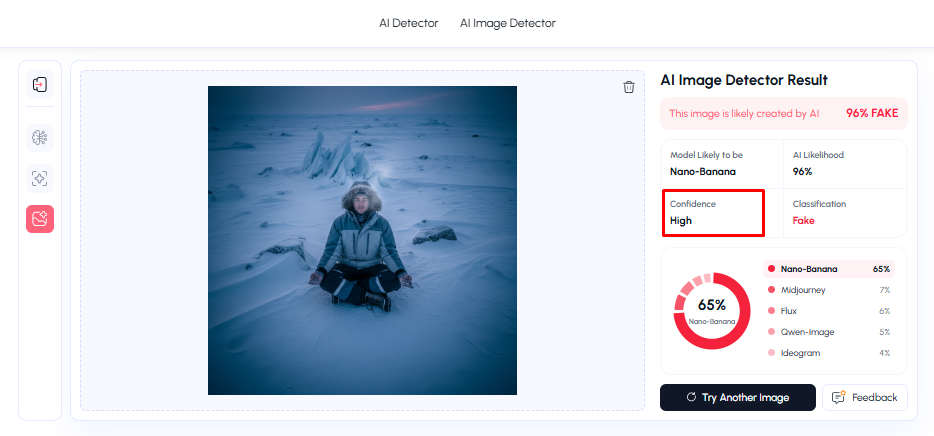
You need to consider these two kinds of information together: For example, if available visual evidence is ambiguous, an image can have a relatively high AI likelihood but a lower confidence level. This distinction helps users avoid treating every percentage as equally reliable.
Classification: Fake or Real
The tool also provides an overall classification. This indicates whether the tool considers the image fake or real. This makes the results much easier to understand.
But you need to consider the classification alongside the AI likelihood, confidence level, heatmap, image source and other available evidence. A binary classification simplifies a much more complicated question.
An image could contain:
A real photograph with an AI generated background
A real person with an AI generated face alteration
A human-created illustration enhanced using AI
An AI generated image edited manually
A photograph heavily processed using traditional software
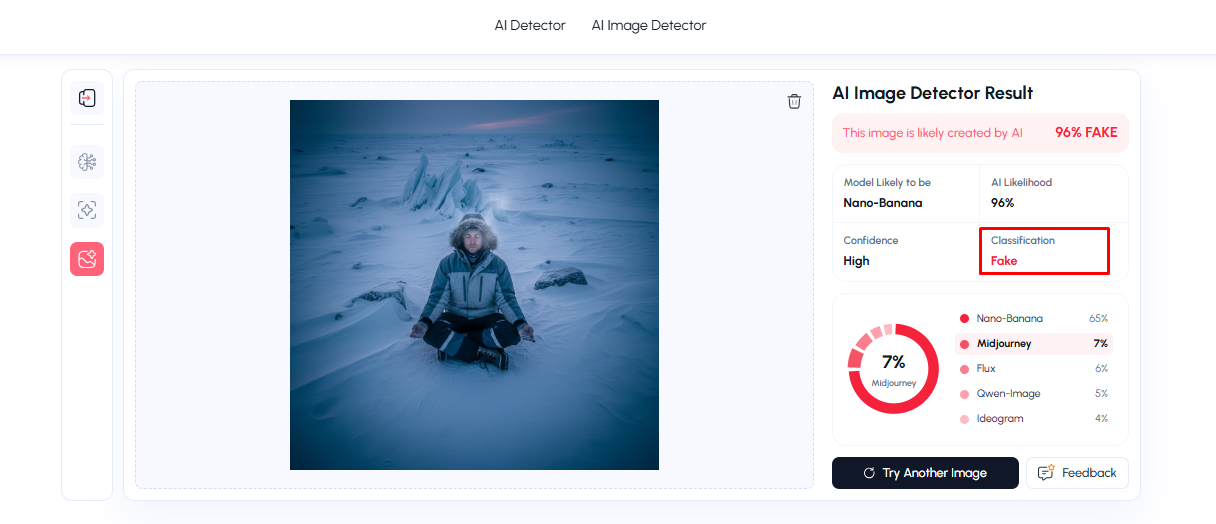
In such situations, simply labeling the entire image "fake" or "real" may not describe the creation process accurately. That is why the additional information you get through the heatmap and model level analysis is valuable.
Stealth Writer Heatmap
One of the most helpful features of Stealth Writer’s image detector is its AI detection heatmap. Many AI detectors provide only a final score. This creates a problem. Suppose a detector says that the AI likelihood is 85%. The user will obviously ask, “Why”?
The percentage alone can’t tell the user about the part which leads to AI detection in the image. A heatmap addresses this problem by providing a visual representation of the areas that contain stronger AI related signals.
The warmer colors such as red, orange and yellow represent regions with stronger AI related characteristics. On the other hand cooler colors such as green and blue indicate regions with fewer detected AI related patterns.
How Does the Heatmap Work?
After an image is analyzed, the detector covers color coded information onto the image. The color indicates varying levels of AI probability. The red color indicates very high AI probability. Orange indicates high AI probability. Yellow indicates moderate AI probability.
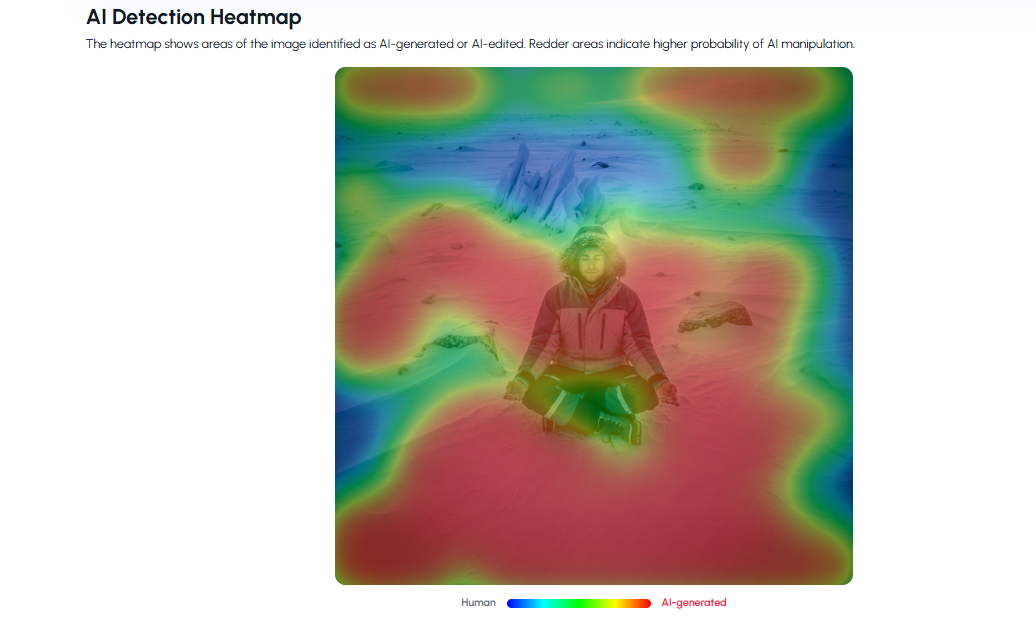
On the other hand, if we talk about cooler colors, then the green color indicates low AI probability. Blue indicates very low AI probability.
The heatmap therefore changes the question from: "Does the detector think this image is AI?" to: "Which parts of this image are contributing most strongly to the AI detection result?"
Why One Accuracy Number is Not Enough?
Below is an example of an AI image. You can see that the image is getting 96% AI probability.
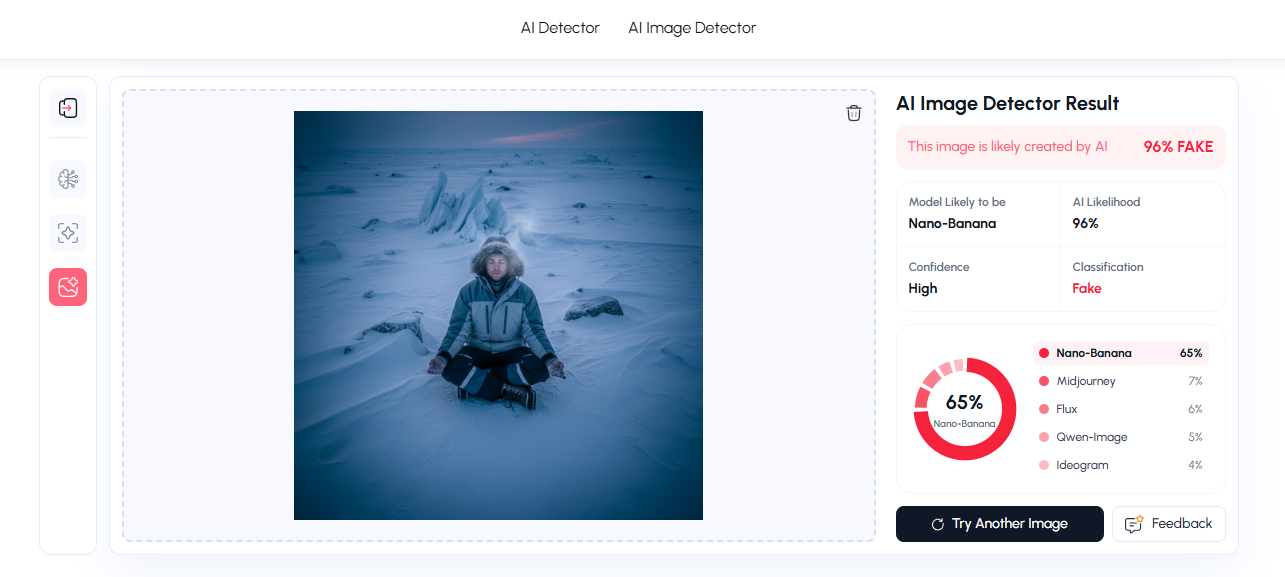
When you see this percentage, you will want to know why the image is flagged as AI. So instead of giving just a score, it gives you an explanation of each
This is why serious evaluation needs to consider the specific population and conditions being tested.
How Reliable Are AI Image Detector Results?
Stealth Writer's AI Image Detector provides a detailed and reliable way to analyze whether an image contains AI-generated characteristics. Instead of relying on a single AI percentage, it combines AI likelihood, confidence level, suspected AI generator, per generator analysis, classification and a heatmap to provide a more complete picture.
By combining these signals, Stealth Writer helps users understand not only whether an image appears AI-generated, but also why it was detected.
It also helps you know which parts of the image contribute to the result. This makes the detector a practical tool for analyzing and verifying AI-generated imagery.
FAQs
Can editing an AI-generated image affect detection?
Yes. Significant editing changes the visual patterns. The detector looks for these patterns. Resizing, cropping, retouching, filtering, adding elements or processing an image through different software can affect the final detection result.
Does image resolution affect AI detection?
Image quality can affect AI detection. Blurry, compressed, very small or heavily processed images provide less visual information to an AI image detector. This can make the result less certain.
Can screenshots be detected as AI-generated?
A screenshot can still contain detectable visual characteristics. But the process of taking and saving the screenshot can change the original image. As a result, detection results can differ from those obtained from the original file.
Can AI detectors identify images from different AI generators?
Stealth Writer AI image detector can analyze characteristics associated with particular image generation systems. However, model identification should be treated as an indication, especially when an image has been edited or processed after generation.
What is the difference between AI likelihood and confidence?
AI likelihood tells about how strongly an image resembles AI-generated content. Confidence describes how certain the detector is about its outcomes. These probabilities provide different information. These are more useful when considered together.
Can an AI image detector tell exactly how an image was created?
Not necessarily. The detector can only provide clues about whether an image contains AI related characteristics. But it generally cannot reconstruct the complete creation or editing history of an image from the pixels alone.
Can AI-generated images become harder to detect over time?
Yes. Image-generation technology continues to evolve, and newer models may produce visual patterns that older detection systems were not specifically trained to recognize. Detection systems therefore need to be continually evaluated and updated.
Can AI detection identify partially AI-generated images?
It may identify AI-related characteristics in portions of an image, but mixed-content images are more complicated than a simple AI-versus-human classification. For example, an image could combine a real photograph with AI-generated elements or contain manually edited AI content.